The Asian Venture Philanthropy Network (AVPN) conference in Bangkok, Thailand this month in June saw several hundred attendees huddle over three days to get a sense of the social investment opportunities in Asia.
One key takeaway from the event is the need for the region to march its social economies and SDG scores in lockstep with its noteworthy economic growth in past decades.
During the conference, two reports by AVPN evidenced the need – one covering north and south Asia (China, Hong Kong, India, Japan, Korea and Taiwan) and the other covering southeast Asia (Cambodia, Indonesia, Malaysia, Myanmar, Philippines, Singapore, Thailand and Vietnam).
Who Scored High Vs LowHow Countries in the Region Scored
Singapore, India and South Korea have the most mature social economies while Taiwan, Vietnam and Cambodia have the most opportunities to improve. For a country to have a “mature” social economy, AVPN says, a number of “actors” must be in play in its social ecosystem – government, social investors, social ventures and intermediaries.
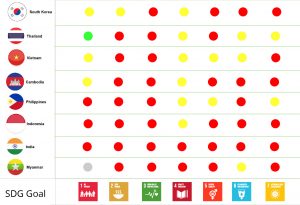
Southeast Asia’s most challenging SDG is the footprint or the impact of human activity on its land areas. A dashboard of the report – a sea of red scores – notes that environmental issues are numerous – climate risk, natural resources management, sustainable management of its forests, management of energy access and infrastructure.
Government involvement varies widely across the region. A number of organizations suffer formal state or legal entity recognition and thus find it very difficult to attract investment. Instead, intermediaries have been taking up government’s mantle whether those activities have involved partnerships, incubations or collaborations.
One bright spot – South Korea is the only east Asian country that legally recognizes social enterprises. The country offers a number of useful incentives including payroll subsidies, sales channel partnerships and preferential procurement from social enterprises.
The South Korean government is also the largest social investor and incubator in the small country. The Korean Social Enterprise Promotion Agency (KoSEA), a state-run incubator for social enterprises, the Korea Social Investment Fund (KSIF), the Korean Poverty Reduction Fund (KPRF), the Seoul Social Economy Network, are well established. (see TechCrunch’s coverage in 2016)
South Korea is also among advanced Asian economies like Japan, Hong Kong, Taiwan, Malaysia and Singapore that are starting to practice ESG when making investment decisions, and paving the way for practicing responsible investments, making more types of investments more mainstream.
Some of the vehicles that are emerging include ESG bonds, socially responsible exchange traded funds (ETFs), corporate sustainability indices and green bonds.
Wealth Changing Hands
Social economies aside, the Asian region remains a substantial magnet for wealth management.
The region’s aging billionaires will at some point pass the wealth baton, Wayne Ma and Jake Watts of the Wall Street Journal assert. Opportunities are sure to be found as younger heirs to that wealth face new challenges.
Sources: AVPN, Techcrunch, Wall Street Journal