About 25% of children worldwide, or at least 700 million, see their childhoods end too soon, according to a report over the summer by the non-profit group Save The Children.
Malnutrition, conflict, child marriage, early pregnancy, economic exclusion and child labor – “childhood enders” – are among the many factors that impede children’s young lives across all regions in the planet.
Dr. Jill Biden, former U.S. Vice-President Joe Biden’s wife and Save the Children’s board chair, and Carolyn Miles, president and CEO of the non-profit, highlight the significance of their findings (watch their video).
Why This MattersAn Existential Threat
These conditions constitute an assault on the future of the world’s children and is, in a way, an existential type of threat to the future of humanity, the report’s authors say.
Depriving the world’s children today degrades humanity’s overall capacity to supply tomorrow’s minds with abilities to solve its biggest questions and toughest problems.
An investment in today’s children represents an investment in the future.
Communities across all countries, rich and poor, can do a better job of ensuring every child enjoys the right to a childhood, the report urges.
Using a “Childhood Index,” the non-profit has ranked 172 countries on who are succeeding, or failing, to provide conditions that nurture and protect their youngest citizens.
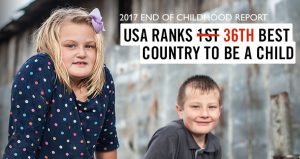
The United States ranked #36 in the list, below most other western nations in Europe and – a surprise – even below other countries like Bosnia or Qatar and just a notch above Kuwait and Russia.
The Eight Enders
Among the statistics cited, are what the report calls the eight “childhood enders.” They are:
- 263 million are out of school
- 168 million are in child labor or are in exploited, hazardous work
- 156 million under age 5 are stunted in growth
- 40 million girls marry young (15-19 years old)
- 28 million are children-refugees
- 16 million are young mothers (15-19 years old)
- 8 million die prematurely (0-19 years old)
- 75 thousand die by homicide (0-19 years old)
Challenges to childhood are most pronounced in West and Central Africa.
The top 10 countries with the highest child homicide rates are all in Latin America or the Carribean.
The top 10 countries with the most children refugees are the same countries the current U.S. administration has issued travel bans against – Sudan, Yemen, Iraq, Somalia and Syria.
Calls to Action
The report urges a number of broad actions, placing most of the burden for “child-ender” solutions squarely on governments, although there is certainly room for donors, philanthropic innovators and private parties to pitch in.
-
- Invest in children – governments and donors need to raise the necessary resources to invest in basic social services, education, financial security and social protection.
-
- Treat children equally – end discriminatory policies, norms and behaviors such as preventing girls or minorities from access to health services or education.
-
- Count children accurately – to help measure progress, data collection systems should be standardized to ensure no child is left unreported. This would include data by age, economic group, gender, sex, race, ethnicity and geography, immigration status.
Read Some More
“End of Childhood Report,” Save The Children Foundation, 2017.
“Jill Biden Named Board Chair of Save The Children Foundation,” Delaware Online, February 2017.
“Children On the Move,” UNICEF Series on Uprooted Children, 2017.
Highlights in the series:
-
-
-
- Among the millions of Rohingya refugees who have fled Myanmar, more than half, or 300,000, are children.
- Nearly 2.2 million Yemeni children are acutely malnourished, and an estimated 460,000 children under 5 suffer from severe acute malnutrition.
- 1.75 million Syrian children are no longer in school and some 2.5 million are living as refugees or on the run in search of safety.
- An estimated 850,000 children have been forced to flee fighting in the Democratic Republic of Congo’s Kasai provinces. Of those, 400,000 severely malnourished children are at risk of dying.
- In the Philippines, 1.8 million abandoned children live in slums in the NCR, in areas like the “Smokey Mountain” trash hills in the capital.
-
-