Investing in ESG related stocks does not necessarily increase risk to portfolios, and in fact can produce higher returns, says a study by Granito and Partners.
The study, utilizing the Dow Jones Sustainability Index to identify 157 firms, found that returns ranged from 2.25% to as high as 31.84%, in energy, health care and food/beverage in particular.
Complemented by Other Studies
Granito’s finding complements other studies centered primarily on the correlation between returns and ESG. Among them include studies published by Cambridge Associates and the Global Impact Investing Network, Allianz Global Investors. All demonstrate that integrating ESG factors do not inherently introduce portfolios.
Bias remains however, as a recent survey by RBC Global Asset Management suggests. Invest Impactly will plans to write a post on biases in the near future.
***
Several investors are demanding more quantitative studies on the link between ESG and risk. Is there a difference in the average of the standard deviation of stock prices of companies with good ESG ratings vis-a-vis stocks with bad ESG performance? Is it possible to quantitatively demonstrate this difference, and establish that ESG firms bear less risk compared to non-ESG stocks? And, critically, since lower risk has traditionally meant lower financial returns, how can ESG investment really be a viable investment strategy?
A new study conducted by Granito & Partners in collaboration with Madrid’s IE Business School has shed light on this issue. Just published by the Journal of Sustainable Finance & Investment and available on Granito’s website, the study … identified 157 firms using the DJSI against a randomly selected pool, a greater number of companies — 809 — that are not listed on the DJSI. As the materiality of the ESG factors is highly related to the industry in which the firm operates, the study grouped equity stocks into 12 industries. The authors of the study are N.C. Ashwin Kumar, Camille Smith, Leila Badis, Nan Wang, Paz Ambrosy and Rodrigo Tavares.
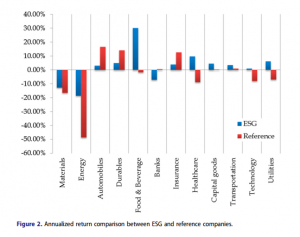
The results are striking. In all 12 industries studied, the group of ESG companies listed in the DJSI, shows lower stock return volatility in comparison to the reference companies — on average by 28.67 percentage points less. But risk varies according to industry, with a stronger impact in materials, banking, energy and technology.
The difference ranges from 6.1 percentage points (for food and beverage) to as much as 50.75 percentage points (the energy industry). This difference of percentage is a risk premium that the reference or non-ESG companies face and that investors should take into consideration when making investment decisions. (Risk was calculated using Sharpe and Treynor ratios.)
In contrast to conventional thinking in which lower risk means lower return, the model shows that even with a lower risk, the investment could achieve a higher equity return. The majority of the industries that were studied (eight of the 12) resulted in better returns for ESG companies than their peers — ranging from 2.25 percentage points to 31.84 percentage points higher.
Across all 12 industries, the positive effect on equity return is 6.12 percentage points higher for ESG companies on average. And, if one looks at only the eight industries with clearly higher ESG returns, this difference jumps to an average 14.08 percentage points for ESG companies compared with their peers.
The industries of energy, food and beverage, and health care show the highest advantage regarding the positive impact of good ESG practices on the stock return (lower risk and higher return).
It becomes clear, therefore, that ESG factors give investors a more complete picture of business opportunities, reducing risk and improving alpha.