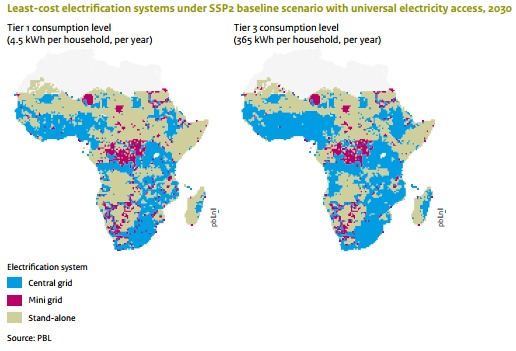
Investors and development efforts may be overlooking the most economical ways to make electricity more accessible in rural Africa, a report by PBL Environmental Assessment Agency says. PBL is an autonomous research institute in the fields of environment, nature and spatial planning based in the Netherlands.
Why This Matters
Improving access to electricity is a vital infrastructure component in a region where two out of every three people, more than 600 million (nearly twice the population of the U.S. by comparison), currently do not have access to electricity. 90% of that population live in rural parts of Africa (see video below).
Achieving universal access to electricity in the region means greater ability to use other critical technologies like irrigation, modern health services, schools and access to the Internet.
Demand is also increasing, driven largely by economic growth in many rural parts of Africa. A population of 530 million to 600 million additional people is anticipated by 2030, tripling total expected household electricity requirements as a result.
To meet projected demand, investments to increase access to electricity will require between $9 billion and $33 billion each year through 2030, the report says, both through public and private financing.
Follow The Money
Additionally, most of today’s energy investments in the region are focused on the maintenance and operation of existing energy infrastructures and of larger-scale projects. Continuing this trend risks leaving large areas of Africa without electricity behind.
While attaining universal electricity means significant investments in electricity generation and transmission capacity, access is also about extending distribution to meet the needs of households at the edge of energy grids in the region.
This means extending access so customers in rural areas will have the ability to charge their mobile devices, turn on lights at night or run household appliances – mundane needs that are taken for granted by large projects today.
However extending high-voltage transmission lines can be expensive – up to $28,000 per kilometer. One approach to close the gap could be to use renewable energy in remote rural areas where demand is low. Sparse populations might be better off with wind, solar or a mini-hydro plant in conjunction perhaps with their own mini or standalone grids.
Government’s Role
Energy projects that do focus on renewable energy are faced with challenges that will not be resolved by more creative finance alone.
The region’s governments ought to be able to help by supporting the market development of mini-grid and stand-alone systems, and by enabling innovative policies to make electricity more affordable for the poorest households.
Governments are also responsible for identifying development priorities and allocating resources, the report cites (UN-OHRLLS, 2014). “The role of the public sector is essential in enabling the right environment, creating effective regulatory frameworks, and developing implementation strategies.”