A new report by Greenwich Associates and American Century Investments found that platform-level decision makers and financial advisors disagree about nearly all aspects of impact investing.
Views varied widely on, for example, fundamental questions of how to define what impact investing is, how to measure impact and how to assess tradeoffs between financial and social impact.
Why This Study Matters
The study highlights that, despite common views that impact investing is poised to grow, many in the industry remain cautious and more guarded.
This isn’t surprising – many, quite frankly, have not really defined what “impact” really means. It often depends on who you ask. Divided views have resulted in divergent interpretations of impact investment strategy, approach, measurement or even management.
For example, the report says that platform decision-makers are divided on how impact investing should be categorized. Some say it should be a standalone category within a portfolio. Others say it should be a type of screen or filter. Others say it should be a combination of either approach.
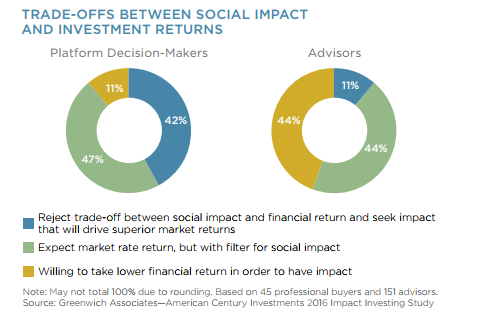
With returns, over half of advisors working at broker-dealers say they are willing to accept tradeoffs in returns to achieve impact. Yet among platform decision-makers, only 11% say they would when asked the same question. In fact, over 40% of those decision-makers say they would reject any type of tradeoff.
Growing Pains
Disagreement can be healthy however as long as it is constructive. Finding a common language to help articulate what “impact” really is and a common measurement framework to assess impact are the key challenges.
Capital markets work, in part, because investment decisions are guided by a common language of risk and return. No matter which advisor an investor seeks investment help from, whether the advisor is from Merrill Lynch or Schwab, common questions on risk tolerance, time horizon and short or long term liquidity can be asked.
Asked about impact however, those same advisors will have differing answers because there are many variations of impact among asset classes, impact areas and investment vehicles. One investor may prioritize microfinance to address financial inclusion in Colombia, while another may prioritize sustainable farming in India. Another may prefer investing in climate bonds to prioritize clean energy, while yet another may prefer social bonds that prioritize sustainable housing.
One approach to resolve these questions could be to utilize an emerging notion called “impact fidelity,” as coined in a recent Harvard article. The approach calls for acknowledging investors’ investment “preferences,” the desired “impact intensity,” and impact “risk profile.”
Another approach needed is for the industry players to agree on common standards, expectations and verification for reporting impact. The industry needs the equivalent of firms like say CrowdCheck, a young company that does third-party due diligence for crowdfunding or Insight360, another young company that measures ESG based on social media, management behavior, and other relevant data.
Finally, one last approach is for industry players to find ways to evolve “impact” out of isolation, utilize “blended” approaches as Jeff Emerson of SOCAP explained last year and in a paper many years ago. Why couldn’t the industry, for example, come up with additional financial numeracies like “Social Share Value,” “Social Equity Ratios,” and “Social Return on Investment” as Mr. Emerson suggested?
As impact investing grows, the industry’s definition of “impact” is expected to become more common. While there is no one approach to impact investing that is right for everyone, the study says, investors will increasingly seek approaches that reject the trade-off between strong investment performance and meaningful and measurable societal benefit.
***
The most striking difference between platform decision makers and advisors is found in their viewpoints about investment returns: While 44% of advisors would be willing to accept lower returns in order to achieve a positive social impact, only 11% of platform decision makers agree.
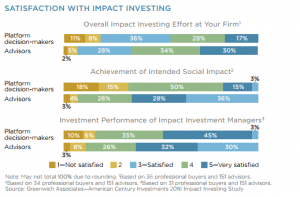
Ninety-two percent of advisors say they are satisfied with existing offerings overall, and similar shares express high levels of satisfaction with the social impact (36% of advisor “very satisfied”) and, separately, the investment performance of their impact investments and managers (30% of advisors “very satisified” versus 45% of platform decision makers). In each of these categories, relatively large shares of advisors rate themselves as “very satisfied.”
However, a full two-thirds of platform decision makers at RIAs say they are not satisfied with current impact investment offerings overall, and half are dissatisfied with the social benefits achieved by their impact investments.
Source: American Century Investments