“We have an opportunity to support each other in building more resilient societies, a more resilient world,” says Jacqueline Novogratz who runs Acumen, during a visit to one of Acumen’s investments, Nizam Bijli, a company that brings affordable solar electricity to low-income communities in rural Punjab Pakistan.
Affordable solar electricity in Punjab’s rural country helps its population weather the region’s extreme heat which at 110F can be withering.
Mind-numbing HeatBeating Pakistan’s Heat
“Most Punjab households consist of eight people sharing a room or two,” according to Ms. Novogratz, who has invested up to $32 million in the region. “The heat can be so intense as to make you question your humanity. It saps your strength.”
Nizam Bijli helps Punjab families power fans that help children sleep through the night, become better students and feel that their lives are improving.
Debates about climate change in Washington, in Paris or in Seoul matter less to these people at times than how to simply get relief from relentless heat in the region.
Nizam Bijli, who makes the low-cost solar products that help power the fans in Pakistan’s remote, underserved communities, says their goal is to provide clean, reliable energy to one million people in the next five years.
“I am a big believer that third world problems will be solved by third world people,” Nizam Bijli’s founder Usman Ahmad has said.
“As a social enterprise, Nizam knows what the market wants. Sure, we’ve made mistakes, but we know what we need to achieve to build something sustainable. We’re not going to waste your money with administrative costs. We want to change the entire space. There is an energy revolution in the works and it’s not just going to happen in Pakistan — it will be global.”
Pakistan’s Changing Climate
As with the raging fires across the world in California of late, Pakistan’s pattern of increasingly hotter days is just one symptom of the world’s changing climate.

“Perhaps the biggest climate threat facing Pakistan today is national security – the possibility of climate change and environmental factors destabilizing Karachi,” says Sualiha Nazar in a post on Foreign Policy.
Karachi, Pakistan’s economic center with a population of approximately 17 million people, is also Pakistan’s main port city, and where its central bank and stock exchange are based. The city generates 50% of Pakistan’s tax revenue and accounts for 42% of its total GDP.
Geographically, Karachi also sits close to the Indus River Delta, where the Indus flows into the Arabian Sea. Rising sea levels have made the delta almost at the same level with the Arabian Sea, threatening land erosion, increased salinity into creeks flowing from the Indus, and increased overall ecosystem instability.
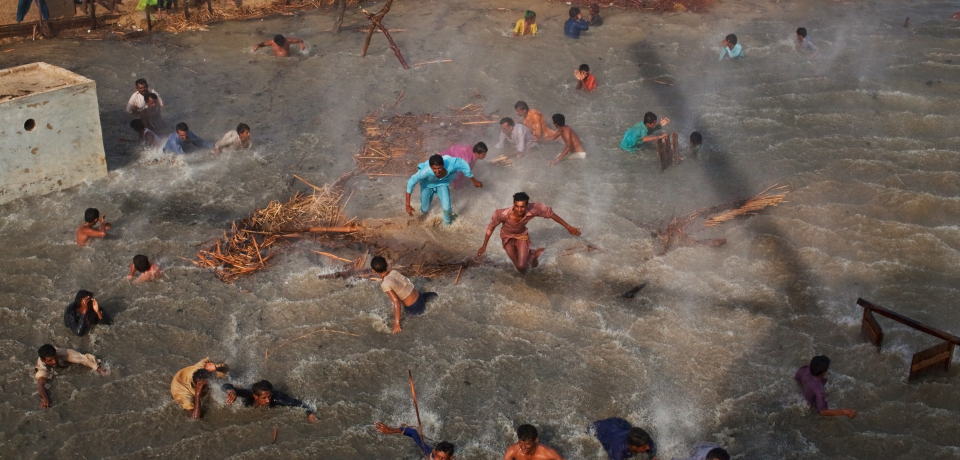
Most importantly, increased sea level now floods increasingly larger and more populated areas.

“Do you think you’re successful?” Usman Ahmad remembers Jacqueline Novogratz once asking him. “In Silicon Valley, no. In Pakistan, yes.”
“If we’re able to do what we’ve set out to do, there’s no reason we shouldn’t be a global company. It’s been a very exciting journey. I mean, my family and friends hate me. I have no social life, but these days I lie in bed at night thinking – we’re doing something right. Just keep going.”
Read Some More
“Building a Resilient World,” LinkedIn Pulse, May 2017.
“Bright Future – How One Man is Bringing Power to His Community,” Medium, 2016.
“Pakistan’s Big Threat Isn’t Terrorism, It’s Climate Change,“ Foreign Policy, 2016.
“The Blue Sweater: Bridging the Gap Between Rich and Poor,” Novogratz, Jacqueline, Amazon, 2010.
The Blue Sweater draws its inspiration from an encounter Ms. Novogratz had during her stint in Kigali, Rwanda.
Ms. Novogratz had spotted a boy who was wearing a blue sweater that, upon closer inspection, (her name was on it) turned out to be the same blue sweater that her mother had given to Goodwill a decade earlier.
This encounter led Ms. Novogratz to realize the interconnectedness of our world, which influences her work to this day.