A report by the Aspen Network of Development Entrepreneurs (ANDE), released in August 2016, suggests that while impact investing in Latin America has reached $1.2 billion (AUM survey), its growth is being hampered by lack of early stage funding and weaker networks (compared to the US, Europe or India).
Investors headquartered in the region Latin America also often cited negative influences of political and regulatory concerns. Investors headquartered externally on the other hand, cited currency risk, given the recent devaluations of local currencies against the U.S. dollar.
Why This Matters
In a region like Latin America that is as fragmented socioeconomically as well as politically, entrepreneurial solutions have the greatest potential to sustainably solve the region’s biggest challenges.
Impact investing industry must grow across the region to reach this potential.
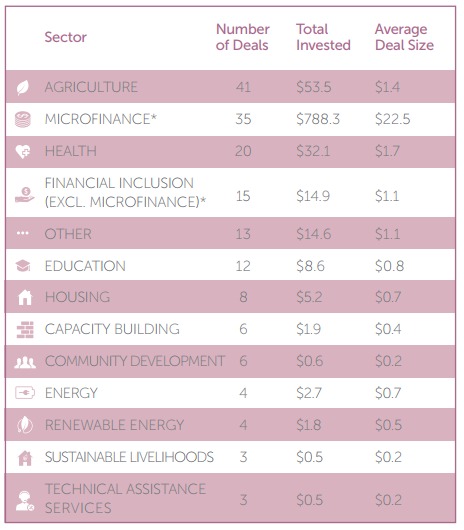
In the survey, microfinance, agriculture and health care were among the top impact areas that investors have funded.
Microfinance, which directly addresses financial exclusion and poverty in the region, alone accounted the lion’s share of funding among all sectors, $788 million or 60% of $1.3 billion invested (see figure above).
Key Findings
- The report surveyed 78 firms in the region, including Brazil, Mexico and Colombia.
- 28 impact investors headquartered in Latin America manage US $1.2 billion in assets under management (AUM).
- The type of organizations making impact investments are diverse in size, in organizational structure, in the type of capital they have been able to raise, and in their relative expectations for financial and impact return on investment.
- Respondents reported US$1.3 billion invested in 522 impact investing deals in 2014 and 2015.
- Respondents remain optimistic about fundraising.
- Across Latin America, common challenges to entrepreneurial development include the lack of interested entrepreneurs with growth ambitions, a lack of early stage funding, and weak networks.
- Excess available capital for impact investing remains, approximately over $2 billion, and which represents an opportunity.
- The majority of impact capital has been raised from institutional investors, such as development finance institutions (DFIs).
- The study did not present any analyses on gender, or the roles women could be playing to grow impact investing in the region. Gender bias is prevalent in the region, according to other studies and reports.
Read More at ANDE