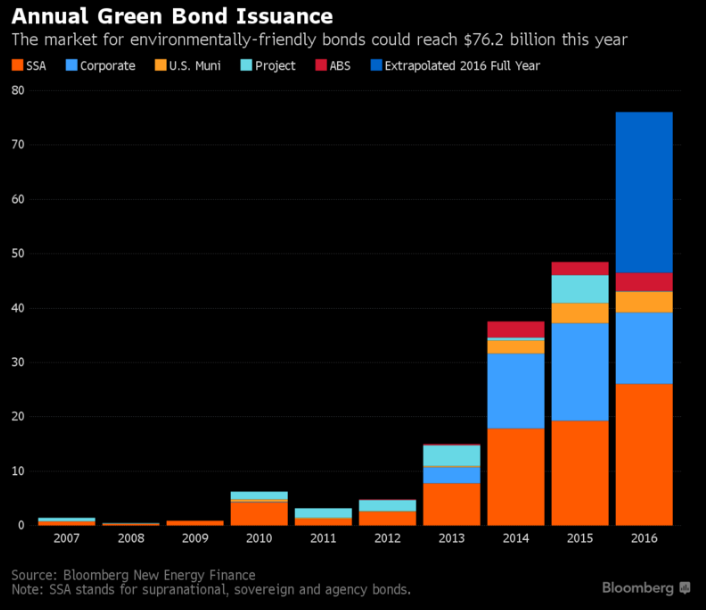
Issuance of green bonds, a tax-exempt investment vehicle to fund projects that have positive environmental and/or climate benefits, grew to about $81 billion globally last year, according to a report by the Climate Bonds Initiative. Growth is projected to nearly double in 2017 to $150 billion.
Growth Factors – Climate Change and Green Bond Standards
Several factors have been responsible for its fast growth, not the least of which has been the loud chorus of government actions to address climate change and sustainable finance. The vehicle is more popular in Europe where climate change has been a bigger rallying cry than in the US, following the passage of the Paris climate accord last year, and because the continent had an earlier head start, issuing its first green bonds ten years ago.
Green bonds are also now increasingly popular in China where dirty air has been an issue – last year, it issued a $37 billion green bond. China was a leader of green bond issuance in 2016, accounting for about 31 percent of all issuance and 65 percent of growth.
Another reason behind the rapid growth of the green bond market has been progress towards establishing a commonly accepted definition of what a green bond actually is, and towards developing standards against which green bonds can be evaluated.
What had started out as a sort of “wild west” market environment led to the establishment of the Green Bond Principles in 2014, a voluntary set of “guidelines that recommend transparency and disclosure and promote integrity in the development of the Green Bond market by clarifying the approach for issuance of a Green Bond.”
Despite the principles, risks of investing in green bonds include transparency or lack thereof and weak reporting, since the principles are voluntary.
Bottom Line – Momentum
With the growth of the green bond market, transparency is becoming more significant, given the rising trend of SRI overall, now a $23 trillion global market. A number of corporate and public bonds are being issued along with new indices that are being used to benchmark new classes of green ETFs, broadening opportunities for fixed income investing in sustainable causes.
***
A range of private and government organizations have issued green bonds, from Apple Inc. AAPL -0.53% and Toyota Motor Corp. TM -1.19% to municipalities, New York’s Metropolitan Transportation Authority and the governments of France and Poland. They have proved popular with investors, with most of the issues oversubscribed, according to the Climate Bonds Initiative.
“These are no longer niche investments,” says Neena Mishra, director of ETF research at Zacks Investment Research.
“I think people are thinking about this more over the long term in terms of being green. So trying to support any bond that has environmental and climate-positive effects is viewed as a good thing by shareholders or pension plan members,” adds Randall Malcolm, managing director and portfolio manager for Canadian public fixed income at Sun Life Institutional Investments Inc.
The growth of the market has sparked interest from fund companies, with the first U.S.-listed exchange-traded fund focused on green bonds—the VanEck Vectors Green Bond ETF (GRNB)—launched in March.
The ETF was launched to meet growing investor demand for environmentally focused products, says Edward Lopez, head of ETF product management at VanEck, an investment-management firm based in New York. The green-bond market has grown large enough in recent years to allow for an ETF to be listed, he says.
The fund tracks the S&P Green Bond Select Index, which was launched by S&P Dow Jones Indices last month to track the most liquid segment of the broader S&P Green Bond Index.
***
Selected green bond developments across the world:
Mexico City, in December, became the first city in Latin America to issue a “green bond,” a $50 million issuance to upgrade lighting, water and transit infrastructure.
Kenya’s Green Bond program kicks off with at least a $600 thousand commitment.
National Bank of Abu Dhabi issues a $587 million green bond, first such bond from the Middle East to be listed on the London Stock Exchange.
Singapore, in June, plans to launch government-sponsored green bond grant incentives. Up to S$100,000 can be granted by the program to green bonds with a minimum issuance value of S$200 million.
Poland, in December, issued a $750 million green sovereign bond, its first.
France, in January, issues 7 billion Euro in green bonds.
The World Bank’s green bond program surpasses $10 billion.
Brazil sets out “green bond” guidelines to help grow its green bond market.
Houston Texas in the US plans to roll out $99 million in green bonds for higher education.
Nigeria plans to delay its planned green bond sale.
***
Sources: Wall Street Journal, Bloomberg, Climate Bonds Initiative Highlights