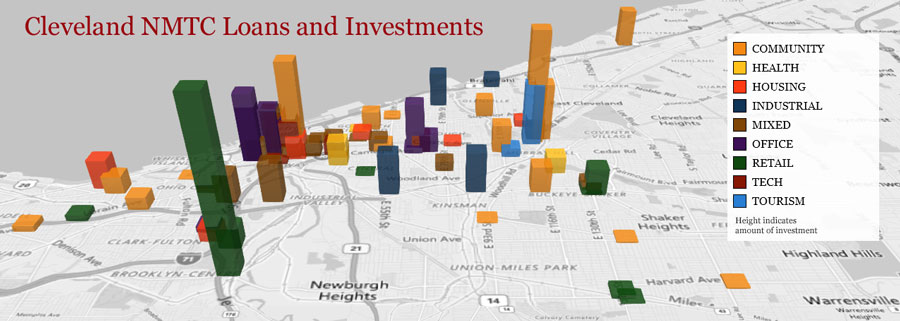
The recent announcement in November by the Community Development Financial Institutions fund (CDFI) that 120 organizations will receive a record $7 billion in New Markets Tax Credit (NMTC) is the largest since its inception in 2001.
With the the clear impact it has demonstrated to ordinary working Americans and communities, such as those showcased by US Representative Pat Tiberi in Ohio, it is worth advocating for it to become more permanent.
NMTC – What It Is
The NMTC program encourages private capital into low-income communities by permitting individual and corporate investors to receive a tax credit against their federal income tax in exchange for making equity investments in specialized financial intermediaries called Community Development Entities (CDEs).
The credit totals 39% of the original investment amount that is claimed over a period of seven years. (CDFIFund.gov)
CDFIs are financial institutions that have a primary mission of promoting community development among their target markets, certified by the US Treasury’s CDFI Fund. There are over 1,000 certified CDFIs in all 50 states, the District of Columbia, Guam, Puerto Rico, and the U.S. Virgin Islands.
The certification is a designation given by the CDFI Fund to specialized organizations that provide financial services in low-income communities and to people who lack access to financing.
Stories of Impact
A historic former commercial garage in North Philadelphia turned into mixed-income housing, small business incubator space and a high-quality childcare facility, a brand-new northeast Washington, D.C., building where 300 adult students annually will receive job training and 30 homeless, low-income families will have affordable housing, are two other examples of NMTC’s positive impact, along with those in Rep. Tiberi’s district in Cleveland, Ohio.
Despite these proven benefits, the NMTC is not yet a permanent part of the tax code. The NMTC program did win some program stability, winning a bipartisan vote of support last year, when Congress reauthorized it for five years instead of the previous pattern of one- or two-year reauthorizations.
However with a new US president and an incoming Republican-controlled Congress, this may or may not change. Stay tuned.
Sources: Cleveland.com, CDFI Fund, NextCity