Islamic Finance, which naturally “embodies” SRI principles owing to strict rules prohibiting investments in tobacco, alcohol, drugs, speculation, gambling has grown fast, tenfold from US$200 billion in 2000 to US$1.8 trillion in a little over 15 years, according to Ibrahim Warde, a professor of international business at Tufts University in Boston, Massachusetts in the U.S. Its total global AUM is expected to surpass US$3 trillion by 2020.
Why This Matters
With the financing gap for SDG estimated to be at US$218 trillion, just over a percent of the value of global capital markets but still substantial, it is crucial that no “innovative sources of finance and leveraging private investments alongside official development assistance” be left unexplored, UN 20-year veteran and Assistant Secretary General Madgy Martinez Soliman advocates.
The segment is popular and has footprint in Asia in countries like Malaysia and Indonesia and in the Middle East. The Americas and Australia are potential future markets, and is ripe for growth in Latin America and Europe, according to a CNBC report in December 2016.
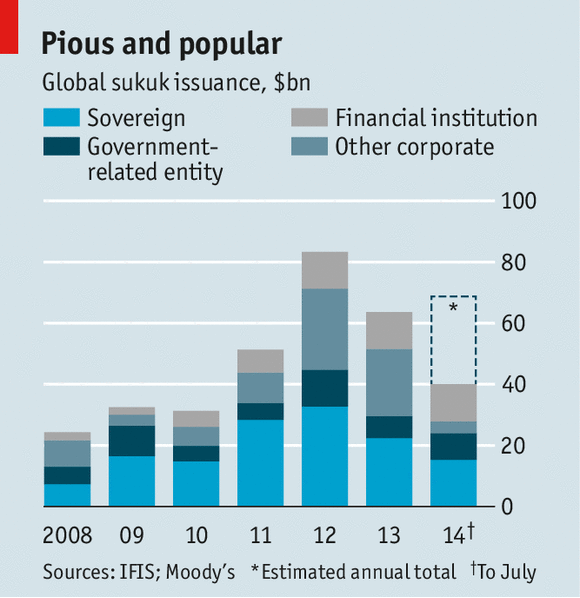
Khazanah Nasional based in Malaysia launched its first M$1 billion social-impact AAA-rated sukuk, the Islamic equivalent of bonds, in the last 2 years to go towards educational projects. Malaysia is the world’s biggest Islamic bond market, accounting for about two thirds of all sukuk sold, according to Reuters, and encourages strict Sharia-compliant financing, according to a Deloitte Finance Energy Report.
Micro-takaful instruments, a type of Islamic micro-insurance, where members pool money together to insure each other against loss or damage, have been deployed in Bangladesh to protect the livelihoods of low-income households, in a country that is chronically ravaged by the planet’s changing climate.
Indonesia announced in September last year that it is ambitiously increasing its issuance of sukuk to around 50% of total debt issuance in 10 years from just 13% last year, responding to what has been a dearth of global sukuk issuance, according to Reuters, despite a surge in sovereign bonds in the Middle East.
Saudi Arabia in February sent an RFP to banks for a US dollar-denominated sukuk, following a large $17.5 billion bond debut in October last year.
In all cases, advocacy groups urge that “impact investing and Islamic finance principles are not incompatible with each other.”
***
“With their rigorous moral and social criteria and emphasis on business-society relations, the principles of Islamic Finance and impact investing are compatible with one another. The two industries resemble each other in a number of ways:
- First, Islamic Financing and Impact Investing are value-based investment structures. In both of these investment structures, investors associate themselves with a moral purpose: The motto “doing good and avoiding harm to others” which constitutes the main underlying ethical principle of both Islamic Finance and impact investing.
- Additionally, both Islamic Finance and impact investing share a broader understanding of the relationship between business and society, one which is centered on advancing human well-being. Although both sectors accept that investors must earn acceptable returns from investments, financial returns only constitute one dimension of investment. Islamic and impact investors also seek to create positive social and/or environmental value alongside financial returns. This eliminates the clash of interest between the investor and society.
- Finally both sectors help build inclusive financial systems which actively integrate the global population that is either directly or indirectly kept out of the formal financial sectors.”
Participants in the market segment and the UNDP are collaborating to share knowledge, formulate policy and promote deals through matchmaking. It is an encouraging development but may suffer bias in the West, given the current hostile political climate in developed regions like the US or parts of Western Europe.
***
“The Islamic Development Bank and UNDP have established the Global Islamic Finance and Impact Investing Platform (GIFIIP).
The Platform acts as a knowledge hub, a forum for policy dialogue and advocacy, and a marketplace for deal sourcing and matchmaking. It promotes market-based solutions to sustainable development challenges, with the aim of positioning Islamic finance and impact investing as leading enablers of global SDG implementation through private sector engagement.
Key aims include developing appropriate investing tools and instruments, and improving access of impact enterprises to Islamic funding.”
Additional readings:
“Faith-based Finance,” The Economist, http://www.economist.com/node/12052679
“Savings and Souls,” The Economist, http://www.economist.com/node/12052687
“Big Interest, No Interest,” The Economist, Pious and Popular
Sources: Huffington Post, CNBC, Reuters, UNDP, Deloitte