The size of the impact investing market has grown to $114 billion from $35.5 billion in 2015 and $25.4 billion in 2013, according to an investor survey conducted by the GIIN which is expected to be published in mid-May.
What’s Changed, is the Growth Real?
The latest GIIN survey is based on 208 survey respondents. Past years’ trend reports were based on smaller sample sizes – 62 respondents.
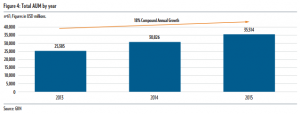
Still, GIIN has been carrying out annual investor surveys for several years and compiling a directory of impact investment funds and products.
By comparison, in another recent study by the GCIA, impact investing, based on that report’s definition of the category, stood at $248 billion in 2016, up from $101 billion in 2014.
Why the higher number? The GCIA report, which covers 500 SRI respondents in the U.S. region alone, includes targeted private market investments, and community investing, where capital is specifically directed to underserved communities or individuals.
Takeaway
Measuring the impact investing market is clearly not easy, so the best way, at the moment, to interpret the differing numbers is from the perspective of the market’s growth trajectory.
Numbers Aside, the Real Significance
“GIIN’s Bouri says that in 2007 and 2008 the Rockefeller Foundation convened meetings at its property in Bellagio – an area that juts into Lake Como, in northern Italy – and that the term impact investing “had come up as a potential label for the use of investment capital to address social and environmental problems”.
It stuck. And has had a big, if you forgive the term, impact.
John Goldstein, co-founder of Imprint Capital, an institutional impact investing firm that was acquired in 2015 by Goldman Sachs Asset Management, where he is now managing director, says that this was a “valuable brand pivot” that allowed “fresh thinking around practices, some of which had built up some ingrained scepticism”.
Bouri says the creation of the brand was powerful because it “connected a bunch of really exciting fragmented efforts into a unified market”.
“It coalesced all these different strategies under a bigger umbrella that makes it easier for large scale global investors to connect with and pursue more holistic strategies that will have an impact on a variety of fronts at the same time,” he says.
Source: Investments and Pensions, GIIN