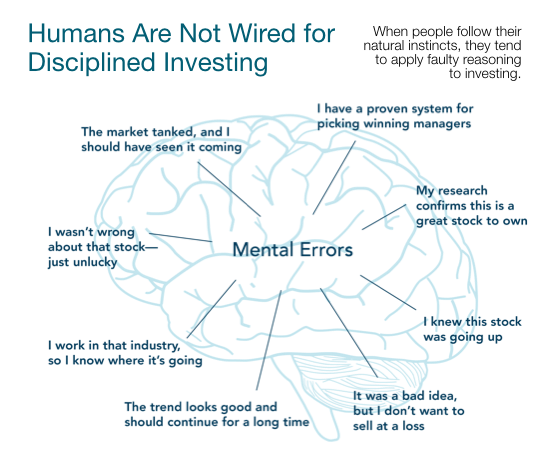
Most investors, on the surface, appear to have everything under control. Many project confidence in their decisions as goals are met, calls are correctly made, or as big bets pay off in big returns.
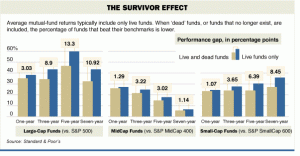
Yet for all the positive publicity of big investment bets that returned billions, less known are those that failed, and consequently, unintentionally in some cases, don’t end up showing in charts due to biases because of gender or like the Survivor Effect (see chart).
Inherent Bias – Downside
Cognitive biases, “thinking patterns based on observations and generalizations that may lead to memory errors, faulty logic and bad decisions,” have been shown by research and data to affect investing decisions.
“People are inherently biased and our unconscious biases affect our decisions and perceptions,” according to Dr. Khatera Sahibzada, an industrial/organizational psychologist who helps VCs and start-ups identify talent by developing better assessment and selection processes.
Fears of the unknown, or greed due to unbounded excitability can compound the effects of biases, degrade the quality of investment decision-making, and fail to maximize the social utility of impact investments.
Persistent Myths
- Impact investing is all about philanthropy. In fact, impact investing spans a wide range, public, private, fixed income, corporate SRI programs, institutional, retail. In the 2016 annual investor survey by the GIIN, “approximately 90% of investors surveyed had financial returns that satisfied or exceeded their expectations.”
- Impact investing only relates to direct investments. As in the first myth, in fact, impact investing spans asset classes, private/public debt, private/public equity, CDFI, green bonds. “Some families like those in the Toniic, 100% Impact Network are deploying 100% of their investable assets achieving return and impact.”
- There is a lack of domestic opportunities for U.S. investors interested in impact investing. In fact, in the U.S., affordable housing, climate change, homelessness, job training and affordability of higher education continue to be main social issues. “Global societal and environmental issues like hunger, inequality and climate change are regional-agnostic, and there is ample opportunity to invest in the U.S. market.”
- Impact investing is difficult. In fact, “an investor can start by moving cash or cash equivalents to an ethical bank, investing in an impact fixed income vehicle (like a green bond) and picking a fossil-free mutual fund.”
- It’s a Democrat vs. Republican issue. “While partisan disagreement isn’t new, … it’s embraced by both sides of the political aisle.”
Brain Mechanics At Play
Jason Zweig’s “Your Money and Your Brain” helps provide a good resource of the biology and behaviors behind biases. Two notable examples:
- When markets tumble – the brain’s amygdala floods our bloodstreams with corticosterone. Fear points the needle to “Sell!”
- When markets unexpectedly soar – the brain’s reflexive nucleus accumbens fires up in your frontal lobe. Greed convinces you to seize the day. “Buy!”
Prescription – A Sample
Systematic and rigorous decision-making frameworks can minimize biases and improve investment judgement. Here is a sample one documented in good detail by Clint Korver, a venture capitalist at Ulu Ventures.
“The framework I adopted to improve my investment judgment was decision analysis, a rigorous and sophisticated set of tools that have been adopted as best practice in industries analogous to venture, such as pharmaceutical research and development and upstream oil and gas exploration.
All three industries require large amounts of initial capital, face significant uncertainty, and achieve success (if ever) years after the original investment. I found the similarities compelling, and with my academic background in decision analysis (including a PhD from Stanford) and 20 years of experience applying it to a wide range of problems and industries, I was well prepared to develop a decision-analysis framework for venture investing.”
Helpful Resources
Above the Market “10 Most Common Biases”
Bloomberg “Biases Can Cost You”
Kauffman Fellows “Applying Decision-Making Analysis to Venture Investing”
Attempts to use machine-learning algorithms to reduce bias, also bias, against minorities
The BackFire Effect explained in a comic strip
Human cognition may be reaching its limits in solving today’s social problems
***
Sources: Investment News, KSahib Consulting, Vestory, TechCrunch